The short answer
This isn't vet advice. Your vet knows your puppy, so check with them about walk lengths, vaccinations and any joint worries.
The short answer: how long to walk a puppy by age
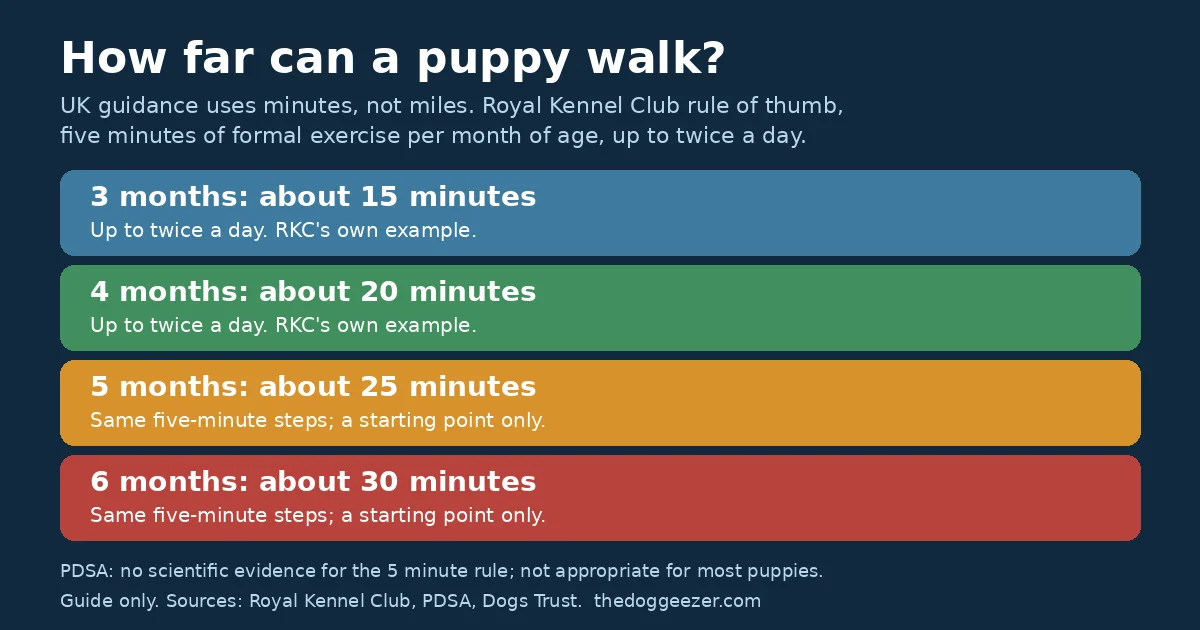
If you're wondering how long to walk a puppy, start with time, not distance. Here's the Royal Kennel Club rule of thumb worked out by age. It's a guideline, not a rule, and it's for formal exercise like lead walks, not play.
| Puppy's age | Formal exercise (RKC rule of thumb) |
|---|---|
| 3 months | About 15 minutes, up to twice a day |
| 4 months | About 20 minutes, up to twice a day |
| 5 months | About 25 minutes, up to twice a day |
| 6 months | About 30 minutes, up to twice a day |
The 3 and 4 month figures are the Royal Kennel Club's own examples; the others follow the same five-minute steps.
On distance, and on how far can a puppy walk in miles or kilometres, no UK charity gives a figure, and it depends on pace, breed and how much sniffing goes on. In my opinion, judging by time and by how your puppy is coping is far safer than aiming for a distance.
Why puppies need short walks
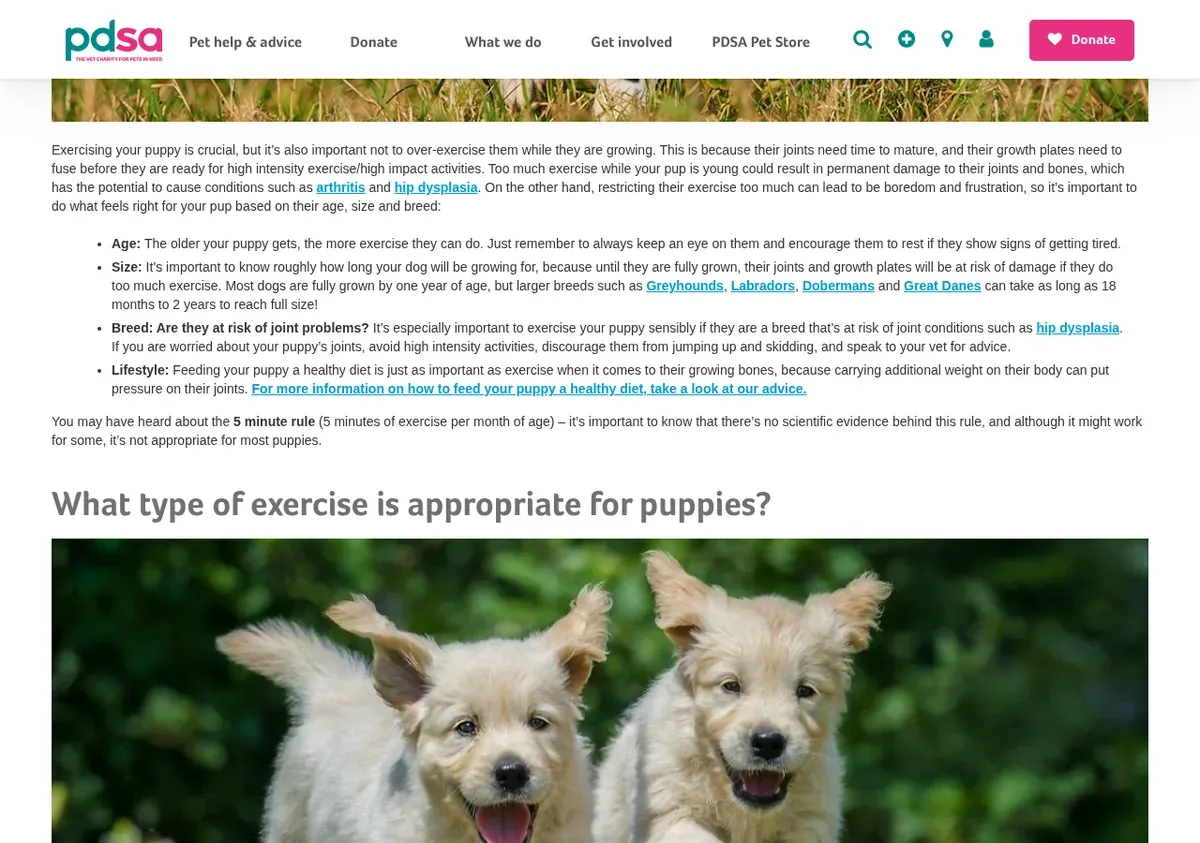
How far can a puppy walk also depends on their joints. PDSA says puppies' joints need time to mature and their growth plates need to fuse before they're ready for high intensity or high impact exercise. Too much exercise while they're young could cause permanent damage to joints and bones, with the potential to lead to arthritis and hip dysplasia.
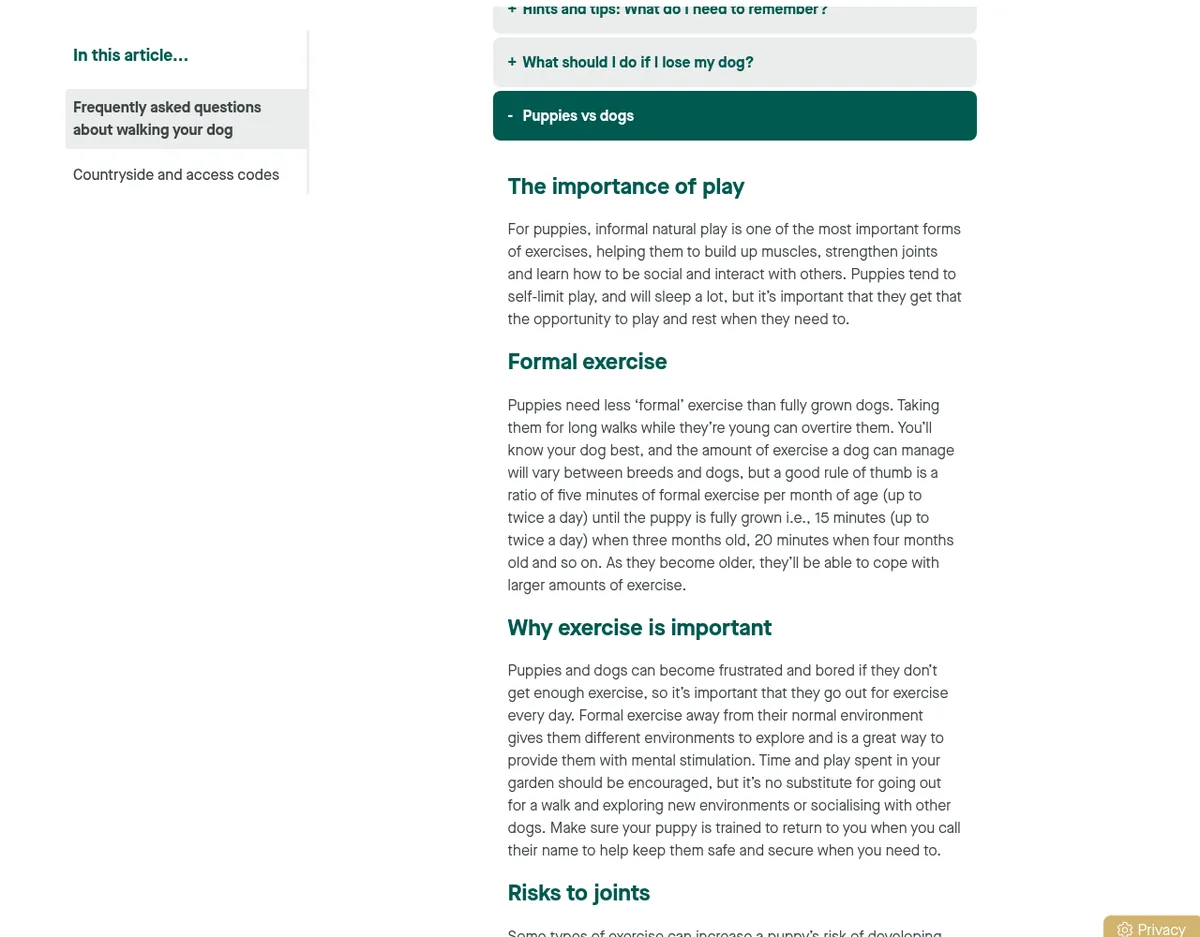
The Royal Kennel Club adds that long walks can overtire young puppies, and that puppies tend to self-limit play and sleep a lot.
PDSA also warns that limiting exercise too much can cause boredom, frustration and behaviour problems. So the aim is short and regular, not none.
How long is "growing"? PDSA says most dogs are fully grown by one year, but larger breeds such as greyhounds, Labradors, Dobermans and Great Danes can take 18 months to 2 years.
Before and after vaccinations
- Before full vaccination: Dogs Trust says a puppy shouldn't be walked outside after only a single vaccination, because they may not be fully protected. You can carry them out in a carrier or secure pram, but they shouldn't walk on the ground.
- The garden: Dogs Trust says your puppy can go out in the garden after their first vaccination, if it's enclosed and not used by dogs with unknown vaccination status.
- First walk: Dogs Trust says puppies can typically go on their first walk one to two weeks after completing their primary vaccination course, but timing varies between vaccines, so check with your vet.
- Keep it short: Dogs Trust says to keep the first walk fairly short and to check with your vet exactly how much exercise your puppy should do. A short, quiet, familiar route helps.
That first outing is usually when people first ask how far can a puppy walk. Keep it shorter than you think, even if they still look keen.
Make sure your puppy is microchipped with up-to-date details before that first walk, as Dogs Trust advises. The new puppy checklist covers what else you'll need.
What to take on a first walk
Dogs Trust says your puppy should be wearing:
- a well-fitted collar
- an ID tag with up-to-date details, including your name and address with postcode
- a lead, or a well-fitted fixed harness (it's a legal requirement for them to still wear the collar and tag)
If you're choosing between a harness and a collar for those first walks, my guide to harness or collar for walking covers the trade-offs.
And take treats, poo bags, and water with a portable bowl or dog water bottle. Dogs Trust suggests saving a longer lead, such as a soft longline, until after the first few walks, so your puppy gets used to their regular lead first. It also says to keep puppies away from ponds and stagnant water because of the leptospirosis risk.
Walks, play and training: what counts
The Royal Kennel Club's five-minute guide is for formal exercise. It says informal, natural play is one of the most important forms of exercise for puppies.
PDSA says play, short walks and training all build a puppy's fitness and confidence, and that training can be just as tiring as playing or a walk. Puzzle feeders and snuffle mats keep their minds busy too.
PDSA also says puppy walks are mostly about exploring the world and meeting new sights, sounds and smells in a positive way. So a slow walk with lots of sniffing is doing its job, and it still counts when you're deciding how long to walk a puppy that day.
An example day for a four-month-old (illustrative only, using the RKC guide): a 20 minute lead walk in the morning with plenty of sniffing, short play sessions and a couple of five-minute training sessions at home, a 20 minute walk later in the day, and lots of sleep between.
Signs your puppy has had enough
PDSA says puppies are unlikely to show obvious signs of being over-exercised until damage has been done to their joints, which is why you need to manage it for them. Its advice:
- Watch them on walks and get them to rest when they show any sign of tiredness.
- If they're tired but won't stop, pop them on the lead and take them out of the situation for a few minutes.
- Leave them enough energy to get home.
In my opinion, signs to watch for include lagging behind, sitting or lying down, and getting nippy or over-excited. If your puppy's nipping more than usual after a walk, my guide to how to stop puppy biting may help.
Surfaces, hills and stairs to avoid
From the Royal Kennel Club (RKC) and PDSA:
- No high impact exercise, such as jumping from heights (RKC).
- No skidding, so avoid games that make them skid (PDSA).
- No sharp, sudden turns, such as chasing a ball, and never throw sticks (RKC).
- No stairs until at least 12 weeks, and longer for some larger breeds (RKC).
- Cover slippery floors at home (PDSA).
- No running, cycling or long hikes until they're fully grown (PDSA).
- No exercise on a full stomach (RKC), as it can contribute to bloat.
- Keep them a healthy weight, because overweight puppies have a higher risk of joint disease (RKC).
Building up to adult walks
Add time slowly as your puppy grows, and keep watching how they cope. PDSA says to always build their walking stamina gradually. Once they're fully grown, my guide to how long a dog walk should be covers adult dogs by size, breed and age.
How far can a puppy walk will change month by month, but the habit stays the same: short, regular walks, then a little more only if they're still happy and sound on their feet.
Lead manners make every walk easier, and starting early helps. If you'd like help with that, see 1-to-1 dog training in Heywood.
Plan the week, not just one walk
In my opinion, it helps to look at the whole week when you decide how long to walk a puppy, not just today's route. Two short walks, play at home, a training game and plenty of sleep is a full day for most young pups. A long weekend hike on top of that is how they get overtired.
If you'd like a hand with those short weekday walks as your pup grows, I offer dog walking in Heywood, and I can keep sessions to the length that suits their age. I don't replace your first vaccination walks or your vet's advice; I just keep the routine steady once they're ready.
Sources I used
- PDSA, Exercising your puppy, opened 21 November 2026.
- The Royal Kennel Club, Puppy and dog walking tips, opened 21 November 2026.
- Dogs Trust, Taking your puppy on their first walk, opened 21 November 2026.
FAQs
How far can a puppy walk?
Not far, and UK charities measure it in minutes rather than miles or kilometres. The Royal Kennel Club's starting point is five minutes of formal exercise per month of age, up to twice a day. PDSA says there's no scientific evidence behind that rule and it isn't appropriate for most puppies, so treat it as a guide, check with your vet and watch for tiredness.
How long to walk a puppy each day?
Use the Royal Kennel Club's five-minutes-per-month starting point, up to twice a day, then adjust. A three-month-old might manage about 15 minutes, a four-month-old about 20 minutes, if they're coping. Play and training also count as exercise, so how long to walk a puppy that day should leave them enough energy to get home.
How long should I walk my puppy for?
The Royal Kennel Club's rule of thumb is five minutes of formal exercise per month of age, up to twice a day. PDSA says there's no scientific evidence behind it and it isn't appropriate for most puppies, so check with your vet and watch for tiredness.
Is a 5 minute rule per month of age correct?
It's a guideline, not a rule. The Royal Kennel Club uses it as a rule of thumb; PDSA says there's no scientific evidence behind it and it isn't appropriate for most puppies. Use it as a starting point only.
Can I walk my puppy before vaccinations?
Not on the ground in public. Dogs Trust says you can carry your puppy out, and they can use an enclosed garden that unknown dogs don't use. First walks are typically one to two weeks after the primary course, but check with your vet.
Can a puppy walk too much?
Yes. PDSA says over-exercising a growing puppy can damage their growth plates and joints, which can lead to early arthritis and hip dysplasia.
How far can a 12 week old puppy walk?
UK guidance uses time, not distance. The Royal Kennel Club's example is about 15 minutes, up to twice a day, at three months. Depending on their vaccinations, your puppy may only just be starting walks at this age, so check with your vet first.
The Dog Geezer
Need a hand with puppy walks in Heywood?
If you'd like a hand with puppy walks as your pup grows, have a look at dog walking in Heywood, Rochdale and Bury, and join the waiting list. Fully insured and DBS-checked.
How far can a puppy walk is a short answer; getting the routine right is the longer one, and I'm happy to help once your vet says they're ready.
Cheers, James
Socialisation and lead skills
In my opinion, a good puppy walk is about the quality of what they see and hear, not meeting every dog or covering more ground. A few calm, happy meetings beat a busy path where they get overwhelmed.
Lead manners make those short sessions easier. Keep early lead practice brief, in a quiet place, and stop while your puppy is still coping. If pulling is already creeping in, my guide to loose lead walking for puppies has a step-by-step plan.