
The short answer
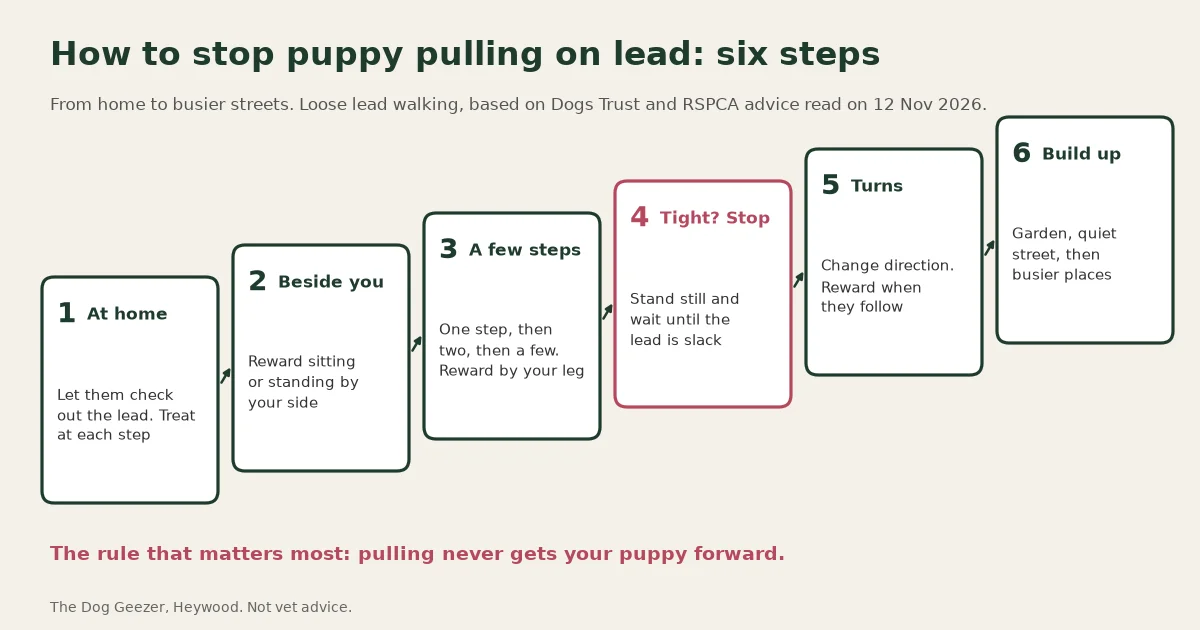
How to stop puppy pulling on lead, in one line: never let a tight lead move your puppy forward, and reward them every time they walk beside you on a slack lead. Start at home, keep sessions short, and build up to the street slowly.
If your puppy pulls like a train, that’s normal. They’re excited, and they quickly learn that pulling gets them where they want to go. The good news is that a puppy hasn’t had years of practice at it yet, so now is the best time to start loose lead walking.
- Never let pulling move you forward. Dogs Trust: “Teach your dog that walking next to you with a loose lead means they get to move forward” and “pulling means they don’t.”
- Make beside you pay. The RSPCA says to “Always reward your dog when they’re walking on a loose lead.”
- Start somewhere quiet. Home or garden first, then build up slowly.
- Keep sessions short and regular, as the RSPCA advises.
- Be consistent. Dogs Trust: “Be consistent with your training each time you go out with your dog.”
Some links in this post are affiliate links. If you buy through one, The Dog Geezer may earn a small commission at no extra cost to you. As an Amazon Associate, The Dog Geezer earns from qualifying purchases.
This isn’t vet advice. If you’re worried about your puppy’s health, joints or behaviour, check with your vet.
What loose lead walking actually means
Loose lead walking means the lead hangs soft in a “J” shape and your puppy moves with you, not against it.
It isn’t about a strict heel. Dogs Trust sums up the goal as “enjoyable walkies with a calm, happy dog who no longer pulls.” Battersea makes the same split: “Some owners prefer a close heel position, while others simply want their dog to walk without pulling. Both approaches use the same foundation skills.”
It’s safer near roads and nicer for both of you. Dogs Trust adds that it’s “a valuable skill if you need to combine your dog walk with taking children out or pushing a buggy.”
Why puppies pull on the lead
Dogs Trust puts it simply: “One of the most common reasons dogs pull on their lead is because they’ve learned that’s how they get to move forward. Whenever your dog pulls, taking just one step with them gives a clear signal that pulling works.” PDSA agrees, noting that “some dogs learn from a young age that if they pull, they get to go forward!”
Add excitement. Walks are full of new smells, sounds and other dogs, and Dogs Trust says that when a dog is excited, “it’s unlikely they realise that you’re being dragged behind them.”
Speed plays a part too. Blue Cross says “A dog’s natural walking pace is usually twice as fast as the average human’s”, which is why it says to reward them generously for walking at yours.
Every time pulling gets your puppy forward, that’s practice. So stopping puppy pulling on the lead is really about making “beside you” the best place to be.
How to stop puppy pulling on lead: what UK charities agree on
To put this guide together, I read the lead-walking advice from five UK charities on 12 November 2026: Dogs Trust, the RSPCA, PDSA, Blue Cross and Battersea. They word it differently, but they agree on the big thing: a tight lead should never get your puppy where they want to go.
| Charity | When the lead goes tight | Kit they mention | Training tip |
|---|---|---|---|
| Dogs Trust | Stop, stand still and wait for a slack lead. If that doesn’t work, walk a couple of steps the other way. | A flat, fixed-length clip lead. No flexi or bungee leads. | Start in your home or garden, and be consistent every time. |
| RSPCA | If your dog moves too far away before the lead goes tight, stop and be still and quiet until they pay attention. | Not covered on its lead-walking page. | Short and regular sessions. Use a toy on the floor as a distraction drill. |
| PDSA | Stop walking. Never pull their lead back. Reward and walk on once the lead is slack. | A harness if they pull. Nothing painful, such as a choke collar. | Train on every walk, start in quiet areas, and phase treats out slowly. |
| Blue Cross | Simply stop, then lure them back to your side with food. | Works on a collar, harness or headcollar. | Ask for a calm sit before the lead goes on. |
| Battersea | Pause and wait for your dog to come back or the tension to ease. | A standard lead around 1.2 to 2 metres. Avoid slip leads. | Make sure everyone who walks your dog follows the same steps. |
Where they differ is small. Dogs Trust and PDSA stand still, Blue Cross lures back with food, and Dogs Trust adds turning away as a backup. Any of these works, as long as pulling never pays.
Kit for puppy walks
Kit won’t stop puppy pulling on the lead by itself, but the right kit makes training easier.
- Flat collar with an ID tag. This is the law. The Control of Dogs Order 1992 says every dog “while in a highway or in a place of public resort shall wear a collar with the name and address of the owner inscribed on the collar or on a plate or badge attached to it.” That still applies with a harness. They also need a microchip, as GOV.UK says “All dogs in the UK must be microchipped and registered by the time they’re 8 weeks old.”
- A comfortable harness or collar for the lead. Dogs Trust says to walk your dog “using whatever piece of equipment is most comfortable for them, such as a flat harness or collar.” It also warns that quick-fix “no pull” products “often cause pain or discomfort”. PDSA recommends a harness if they pull, to “help prevent them from hurting their neck.” Puppies grow fast, so check the fit every week or two. One option is the Ruffwear Front Range harness, and my best harness for dogs that pull post covers fitting. If you’re torn between the two, my harness or collar for walking guide goes through it.
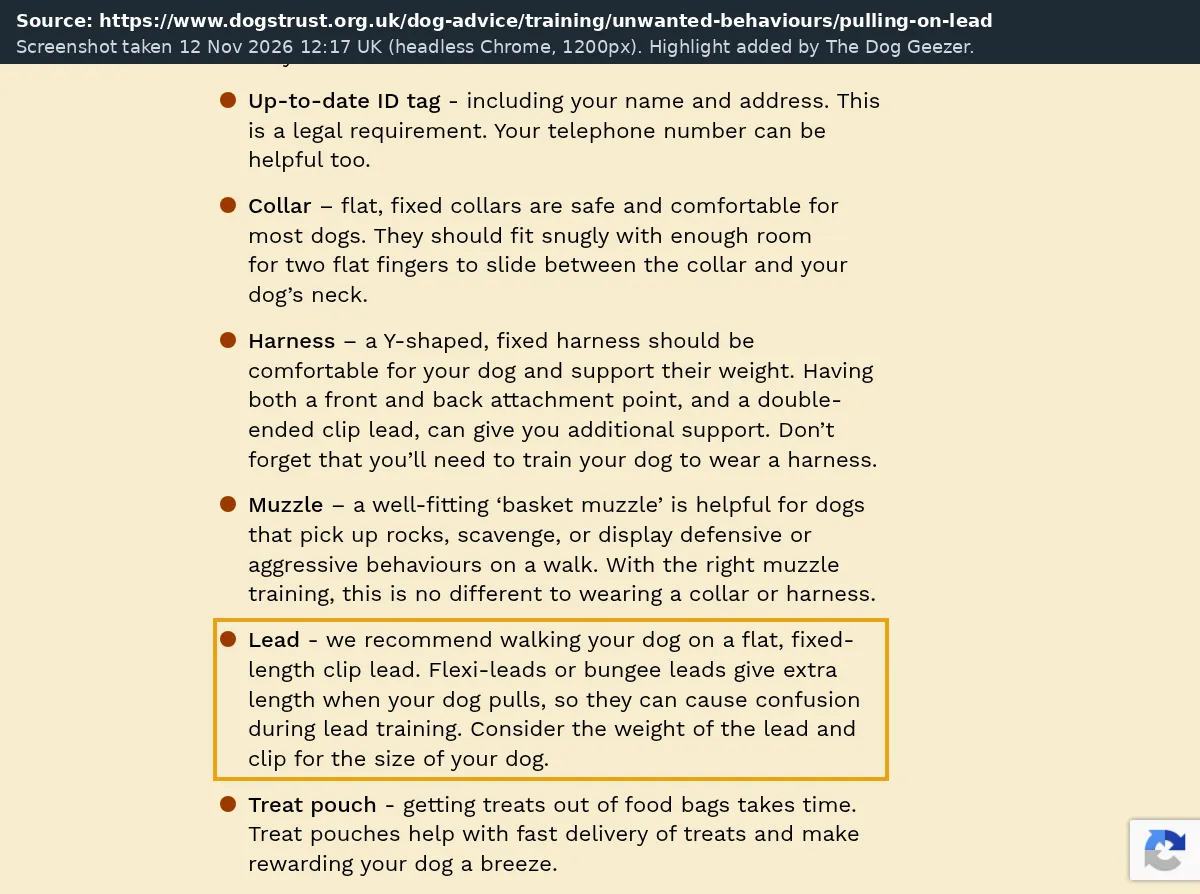
- A fixed-length lead, not an extending one. Dogs Trust: “we recommend walking your dog on a flat, fixed-length clip lead. Flexi-leads or bungee leads give extra length when your dog pulls, so they can cause confusion during lead training.” Battersea suggests a standard lead of around 1.2 to 2 metres, and says to “Avoid slip leads as they can tighten around the neck and cause discomfort.”
- A treat pouch and small treats. Dogs Trust: “Treat pouches help with fast delivery of treats and make rewarding your dog a breeze.” Something like this treat pouch and clicker does the job. To keep weight in check, PDSA advises “only feeding up to 10% of their daily allowance as treats”, and suggests using some of their daily biscuits.
Before you leave the house
A lot of puppy pulling on the lead starts at the front door. If your puppy is bouncing off the walls before the lead is even on, they’ll set off at full speed.
- Burn a bit of energy first. Blue Cross suggests you “take your dog in the garden and attempt to wear them out” before training. PDSA says a long play session beforehand “will tire your dog out a little so they don’t want to pull as much.”
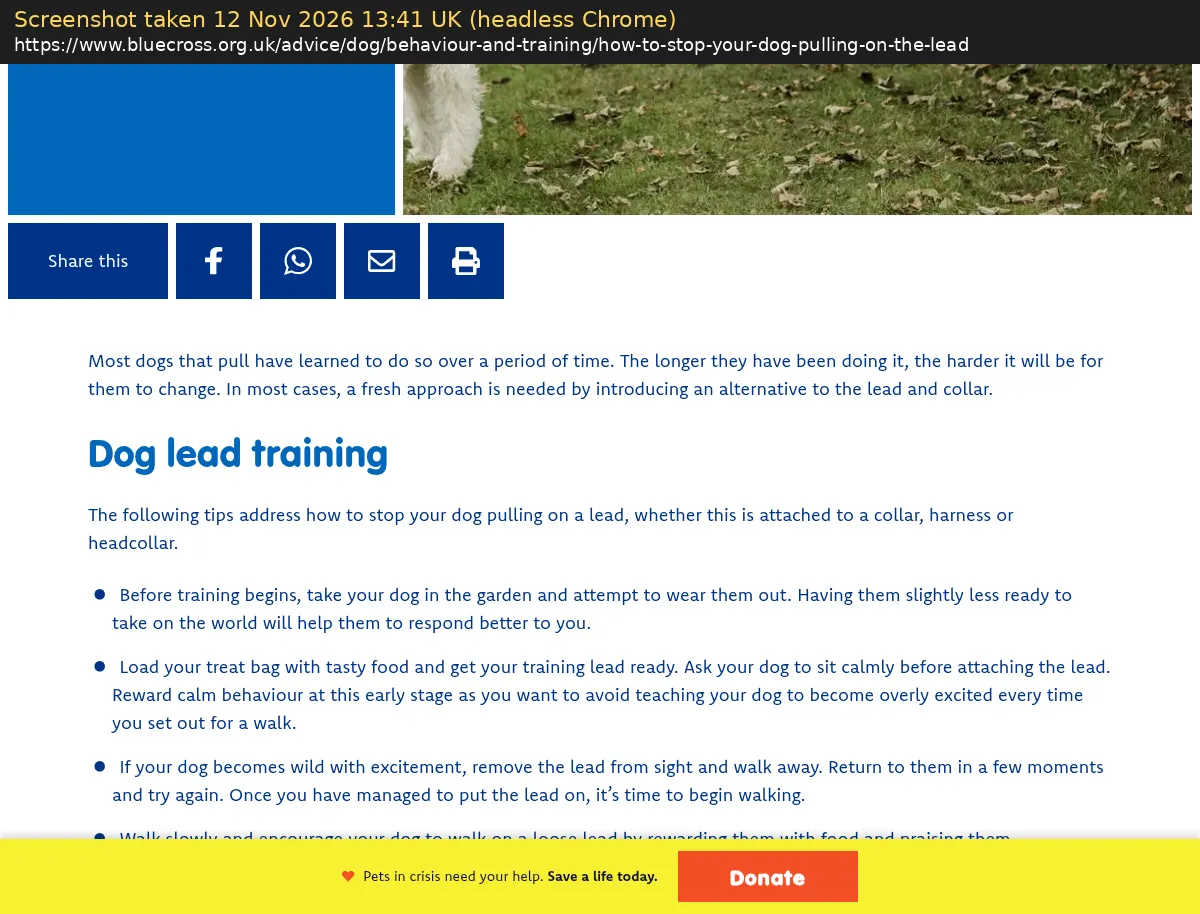
- Ask for calm before the lead goes on. Blue Cross: “Ask your dog to sit calmly before attaching the lead.” If they get “wild with excitement”, it says to put the lead out of sight, walk away and try again in a few moments.
- Take the drama out of the lead. PDSA suggests bringing the lead out often through the day, picking it up and putting it down again, so it doesn’t always mean a walk.
Loose lead walking step by step
This is the heart of how to stop puppy pulling on lead. Six steps, in order, and only move on when the one before is easy.
Step 1: Get them used to the lead at home
Start indoors, before your puppy can even go out. Dogs Trust: “First let them investigate the lead, rewarding with tasty treats as they go.” Then lift it, clip it on and treat at each step.
Step 2: Make “beside you” the best place to be
Dogs Trust: “Starting in your home or garden where it’s calmer, reward your dog for sitting or standing by your side.” Pick one side, keep the treats on that side and deliver them right by your leg. The RSPCA puts it well: “Make the area around you fun and rewarding so that your dog enjoys being closer to you.”
Step 3: One step, then a few
Take one step and reward beside your leg when your puppy moves with you. Then two steps, then a few. Dogs Trust suggests you “practice without the lead attached” at first, then introduce it “once your dog is reliably following you.” As they get the hang of it, Dogs Trust says to “slowly increase the time and distance between rewards.”
Step 4: When the lead goes tight, stop
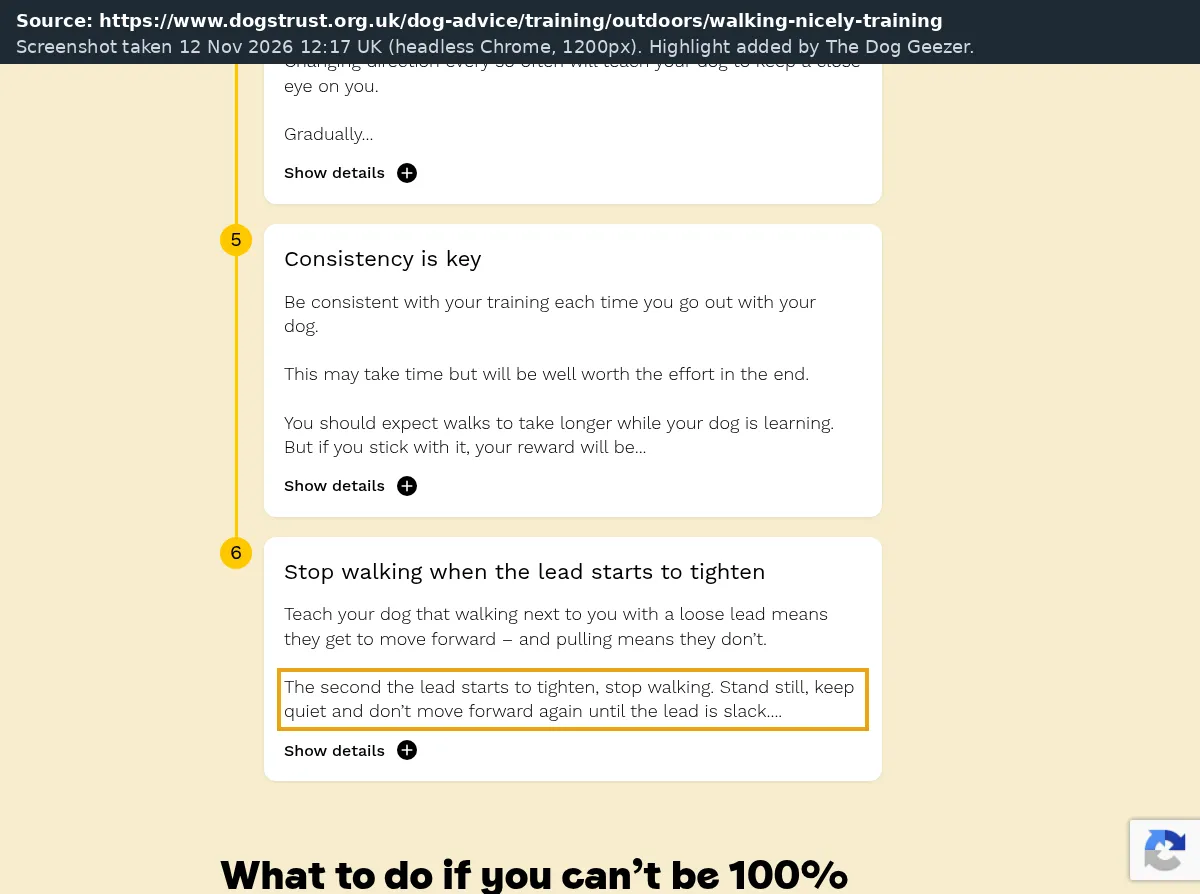
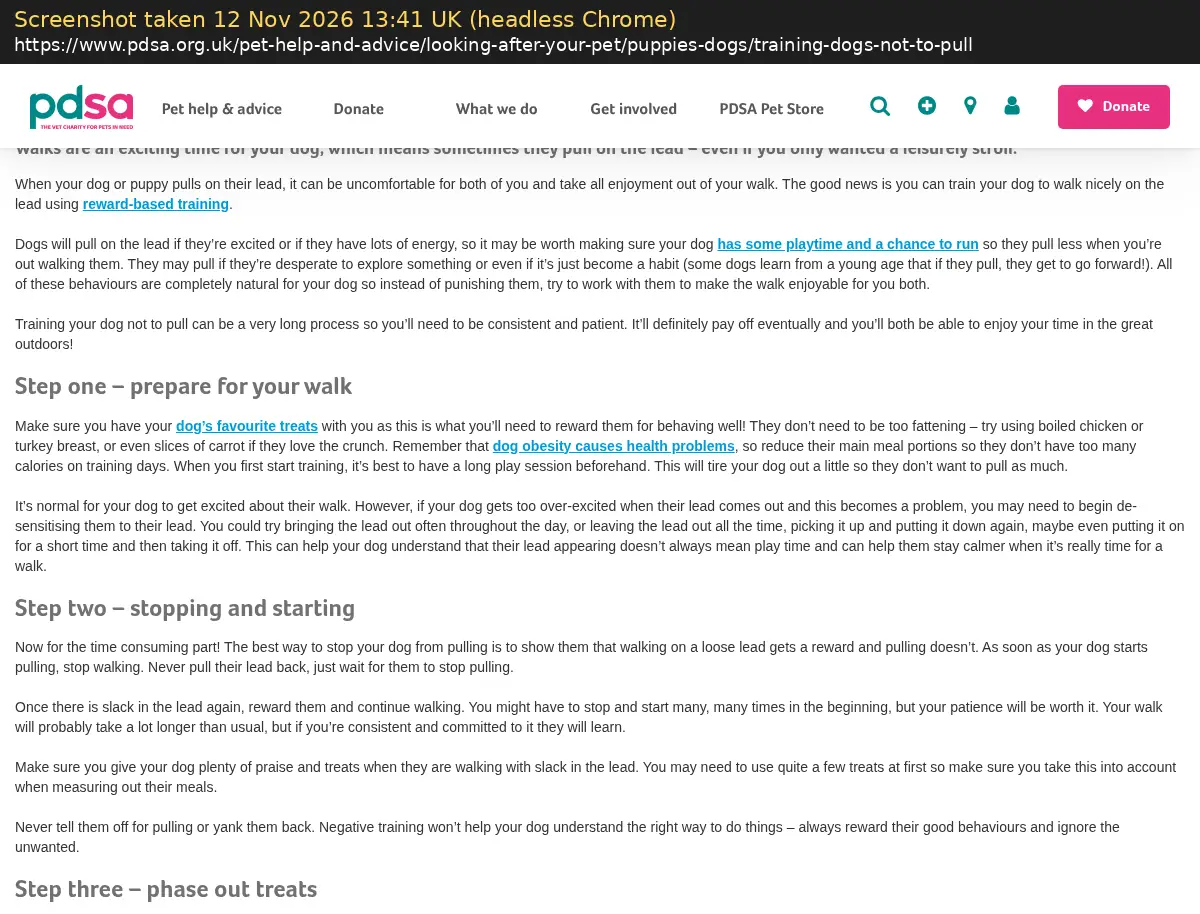
The rule that matters most. Dogs Trust: “The second the lead starts to tighten, stop walking. Stand still, keep quiet and don’t move forward again until the lead is slack.” Don’t jerk the lead or tell them off. PDSA is just as clear: “Never pull their lead back, just wait for them to stop pulling.”
If they don’t turn back to you, Dogs Trust suggests “walking a couple of steps in the opposite direction to get their focus back.” Stopping or turning, both are fine as long as pulling never gets them forward.
Step 5: Add turns, stops and a cue
Change direction and reward when your puppy comes with you. Dogs Trust says “Changing direction every so often will teach your dog to keep a close eye on you.” The RSPCA suggests you “use your voice and treats to encourage your dog to stay close to you when walking.” Battersea also suggests a release cue “such as ‘off you go’” to tell your dog when lead practice is over and sniffing time starts.
Step 6: Garden, quiet street, then busier places
Dogs Trust says it’s “much easier for your dog to learn new behaviours in quiet places where they won’t be easily distracted.” Move up slowly: home, garden, quiet street, then somewhere busier, making one thing harder at a time.
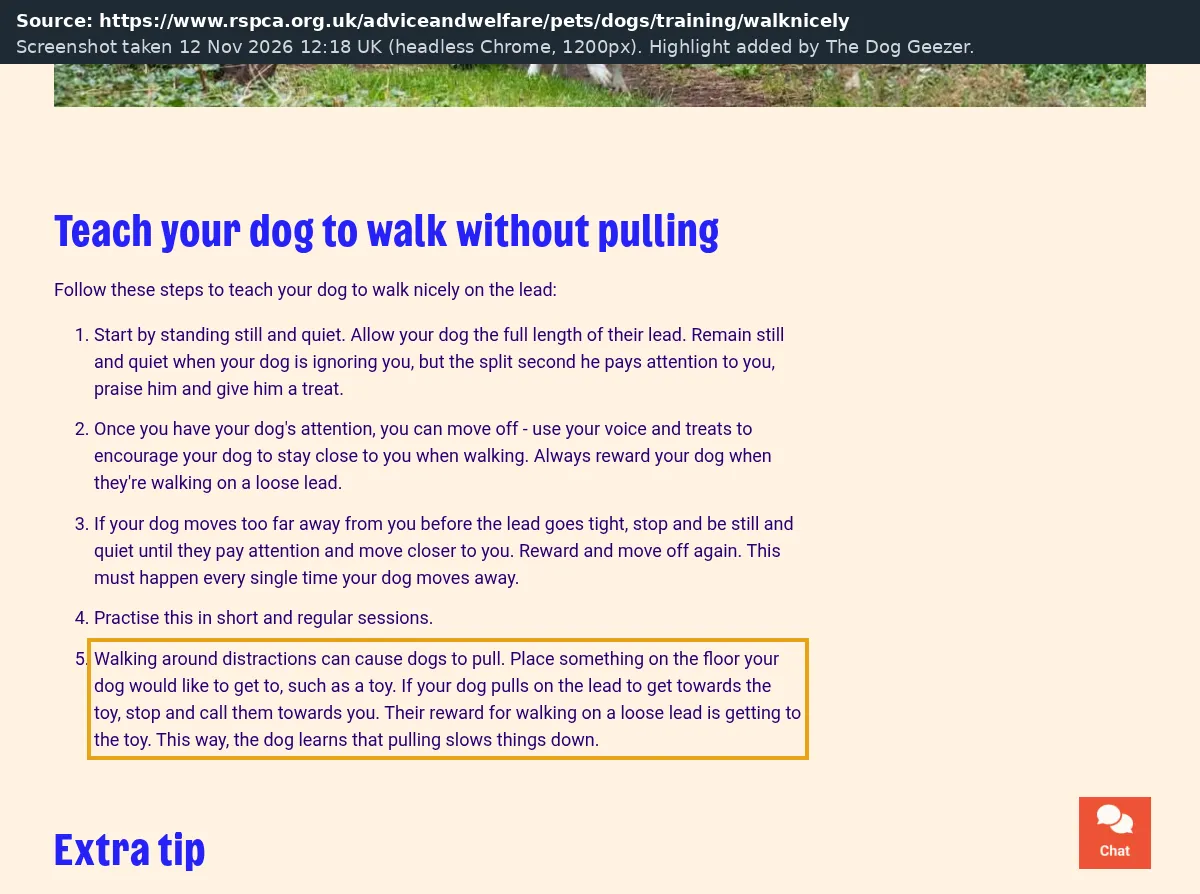
The RSPCA has a good distraction drill. Put a toy on the floor. If your dog pulls towards it, stop and call them back. “Their reward for walking on a loose lead is getting to the toy. This way, the dog learns that pulling slows things down.” Keep it to “short and regular sessions”.
Your puppy’s first walks
Dogs Trust says “Your puppy can typically go on their first walk one to two weeks after they have completed their primary vaccination course.” Check the timing with your vet, as it varies between vaccines.
Take treats, poo bags, water and a bowl, and pick a short, quiet route. Our new puppy checklist has the full “before the first walk” list.
How long should puppy walks be?
You’ve probably heard the “5 minute rule”: five minutes of exercise per month of age. PDSA says “there’s no scientific evidence behind this rule, and although it might work for some, it’s not appropriate for most puppies.”
PDSA’s Weigh Up puppy leaflet gives a rough starting guide instead:
| Puppy’s age | Approximate time per walk |
|---|---|
| 2 months | 10 mins |
| 3 months | 15 mins |
| 4 months | 20 mins |
| 6 months | 30 mins |
PDSA marks it “a starting point only”, and suggests two or more walks a day with playtime in between. Larger breeds such as Labradors “can take as long as 18 months to 2 years to reach full size”, and PDSA advises avoiding high intensity activities if you’re worried about their joints.
So keep walks short, sniffy and steady, and remember training walks count. If you’re unsure what suits your puppy, see your vet.
How long does loose lead walking take to teach?
Longer than you’d like. There’s no overnight fix for how to stop puppy pulling on lead. Dogs Trust says “Teaching your dog to walk with a loose lead takes a great deal of patience and time.” Dogs Trust adds that “You should expect walks to take longer while your dog is learning.”
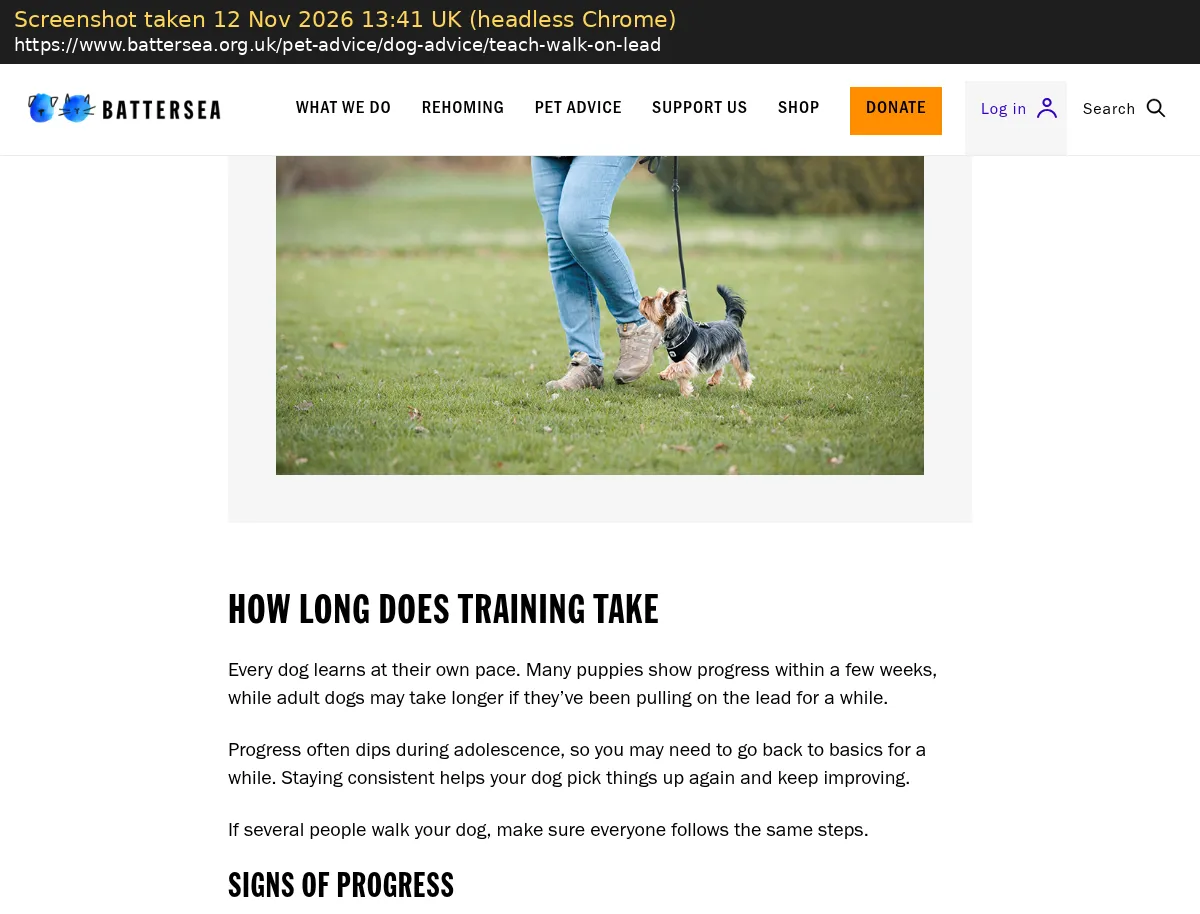
Puppies do have the edge. Battersea says “Many puppies show progress within a few weeks, while adult dogs may take longer if they’ve been pulling on the lead for a while.” It also warns that “Progress often dips during adolescence, so you may need to go back to basics for a while.”
Battersea’s signs that it’s working:
- Your puppy checks in with you more often.
- The lead stays loose for longer stretches.
- They recover more quickly after distractions.
- Walks feel calmer and more predictable.
If your dog is older and already pulls, my how to stop your dog pulling on the lead guide is written for that. Once lead manners are coming on, long line recall training with a 10m long line is a good next step, and my best long line for recall training guide covers length and material.
When it’s not working
Still struggling with puppy pulling on the lead? Check these common snags.
My puppy won’t walk at all
Dogs Trust lists reasons from pain or tiredness to the lead feeling strange, or learning that stopping gets treats. See your vet first to rule out health problems. Never drag them. Go back to the garden for a few days, because “all walking equipment should be introduced gradually and positively.”
Fine at home, pulls like mad outside
Usually too much, too soon. Dogs Trust: “If they are struggling, go back to a stage where they were successful and take things slower.” Go back a step, somewhere quieter, with better treats.
Pulls hardest towards other dogs
Don’t let pulling win the greeting. Stop, or turn and walk the other way, and reward when they look back at you.
Bites or grabs the lead
Dogs Trust calls this “lead ragging” and says it’s “very common”. Pause, swap the lead for a toy and keep sessions short. My puppy biting post has more.
Everyone in the house does it differently
Agree one side and one rule: pulling never moves forward. Dogs Trust says to “Be consistent with your training each time you go out with your dog.” Battersea agrees: “If several people walk your dog, make sure everyone follows the same steps.” If you can’t always train, for example when you’re running late, Dogs Trust suggests a separate harness that gives “permission to pull”, but warns it’s likely to take your dog longer to learn to stop pulling with this method.
And skip harsh kit. Never use choke chains, prong collars or shock collars. PDSA: “Never tell them off for pulling or yank them back.”
Sources
Every quote and rule in this guide comes from these pages. I checked each one on 12 November 2026.
- Dogs Trust: Taking your puppy on their first walk
- Dogs Trust: Why dogs pull on the lead and how to help
- Dogs Trust: How to stop your dog pulling on the lead
- PDSA: Training dogs not to pull
- PDSA: Exercising your puppy
- PDSA: Weigh Up puppy leaflet (PDF)
- RSPCA: Train your dog to stop pulling on the lead
- Blue Cross: How to stop your dog pulling on the lead
- Battersea: Train your dog to walk on a lead
- The Control of Dogs Order 1992, article 2 (legislation.gov.uk)
- GOV.UK: Get your dog or cat microchipped
FAQ
When can my puppy go on their first walk?
Dogs Trust says typically one to two weeks after the primary vaccination course. Check with your vet, because timing varies between vaccines.
When should I start lead training my puppy?
From the first days at home. Lead practice indoors with treats, then the garden, so they’re ready by the time they can go out.
Should my puppy wear a harness or a collar?
Either, as long as it’s comfortable and fits. Dogs Trust says to use whatever is most comfortable for your dog. They still need a collar with your name and address on in public, by law.
Can I use a slip lead or extending lead to train my puppy?
Dogs Trust recommends a flat, fixed-length clip lead, and says flexi or bungee leads “can cause confusion during lead training”. I’d avoid anything that tightens on a puppy’s neck.
Should I stand still or change direction when my puppy pulls?
Both work. Dogs Trust says stand still until the lead is slack, and if your dog doesn’t turn back, walk a couple of steps the opposite way. The key is that pulling never gets them forward.
How do I stop my puppy pulling on the lead?
Make sure pulling never gets them forward. Stop the second the lead goes tight and wait until it’s slack, reward them when they’re beside you, start somewhere quiet and keep sessions short and regular. That’s the heart of loose lead walking.
The Dog Geezer
Need a hand in Heywood or Bury?
If you’d like hands-on help to stop your puppy pulling on the lead, have a look at dog walking in Heywood and dog walking in Bury, or 1-to-1 dog training in Heywood for lead manners, and get on the waiting list. Fully insured and DBS-checked.
Cheers, James