The short answer
There's no single right length. PDSA says most dogs need at least one to two walks a day. As a rough guide, smaller dogs need 20 to 60 minutes of exercise a day, medium dogs around 1 to 2 hours, and larger dogs such as Labradors over 2 hours. That's total exercise, not one walk.
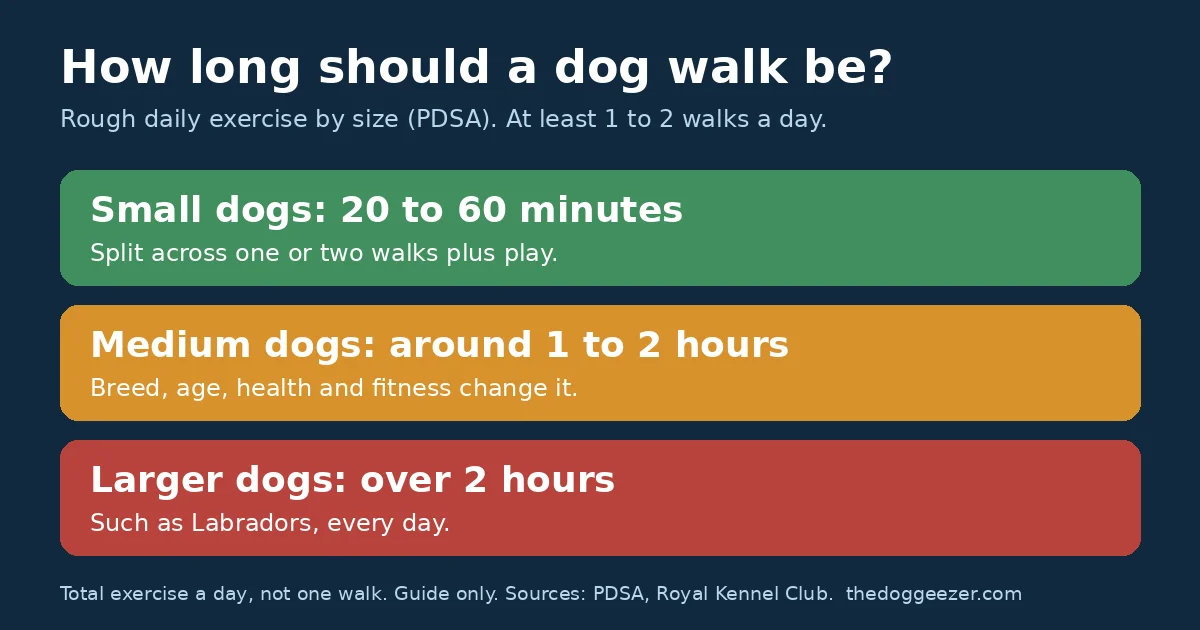
Your dog's breed, age, health, fitness and personality all change the answer, so treat those figures as a starting point and watch your own dog. I'm a dog walker in Heywood, and two dogs the same size can need very different walks.
This isn't vet advice. If you're unsure how much exercise your dog needs, or they have a health condition, check with your vet.
The short answer: how long and how often
- How often: at least one walk a day, usually two. PDSA says most dogs need at least one to two walks a day unless your vet says otherwise, and the Royal Kennel Club says every dog should have at least one walk a day, often two.
- How long in total: it depends on the dog. These are PDSA's rough daily figures, which you can split between walks, play and training.
| Dog | Daily exercise (PDSA rough guide) |
|---|---|
| Small dogs, such as Yorkshire terriers | 20 to 60 minutes |
| Medium dogs | Around 1 to 2 hours |
| Larger dogs, such as Labradors | Over 2 hours |
PDSA also says some breeds need a minimum of one to two hours a day, and working breeds need significantly more.
What a walk is for
A walk isn't just about burning energy. PDSA says walks give your dog a chance to sniff new smells, explore new places and meet new people and dogs, and that all of this matters for their mental wellbeing and confidence. It's also their main chance to go to the toilet somewhere other than your garden.
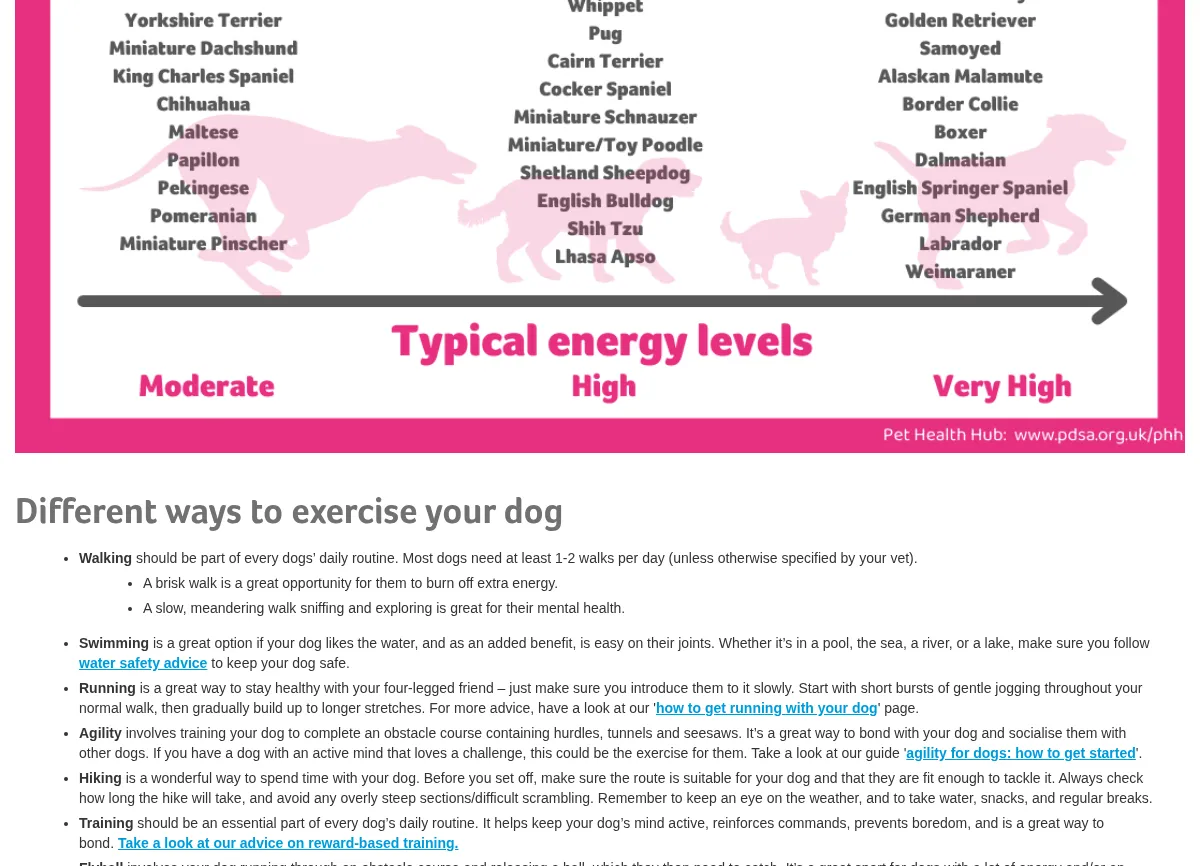
That's why the length of a walk matters less than what happens on it. A brisk walk burns off energy, and PDSA says a slow, meandering walk, sniffing and exploring, is great for a dog's mental health. A good walk often mixes the two.
What changes the answer
PDSA lists five things that change how much exercise your dog needs:
- Breed. Some need a lot more than others.
- Age. Puppies need their joints protecting, adults need to stay fit, and senior dogs may need a little less.
- Health. An unwell or injured dog may need less, and rest is part of recovery. Follow your vet's advice.
- Fitness. Build it up gradually to avoid injury.
- Personality. Make sure your dog is enjoying their exercise.
Walk length by breed
The Royal Kennel Club's Breeds A to Z gives every breed an exercise band: up to 30 minutes a day, up to 1 hour, between 1 and 2 hours, or more than 2 hours. Two examples from its breed pages:
| Breed | Royal Kennel Club exercise band |
|---|---|
| Border terrier | Up to 1 hour per day |
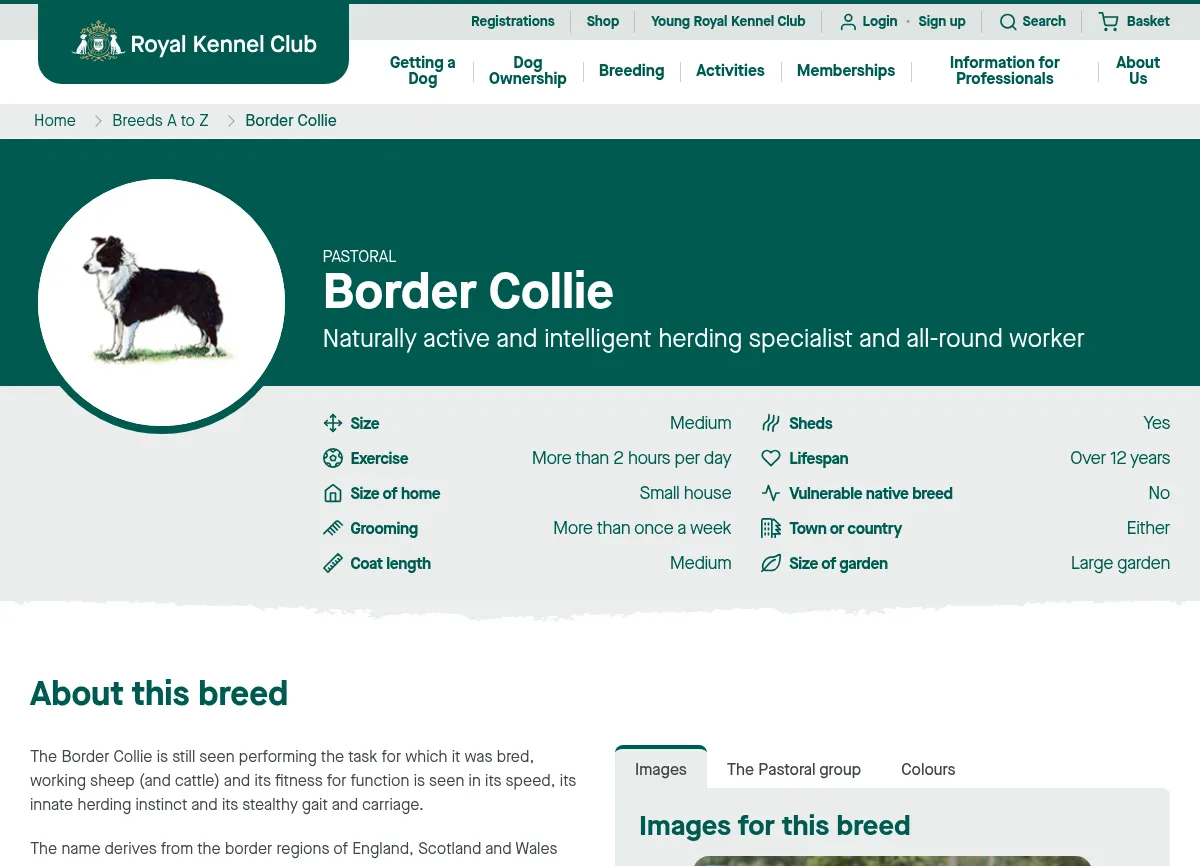
| Border collie | More than 2 hours per day |
Size isn't everything. A Border collie is a medium dog on the Royal Kennel Club's page but needs more than 2 hours a day, well above a walk round the block. Look your dog's breed up on the Royal Kennel Club site for its band and treat it as a starting point. With crossbreeds, in my opinion, it's best to watch how your own dog copes rather than guess from the parents.
How long UK dogs are actually walked
PDSA's PAW Report 2026 asked UK owners how long their dog is walked each day:
| Time walked per day | Share of dogs (PAW Report 2026) |
|---|---|
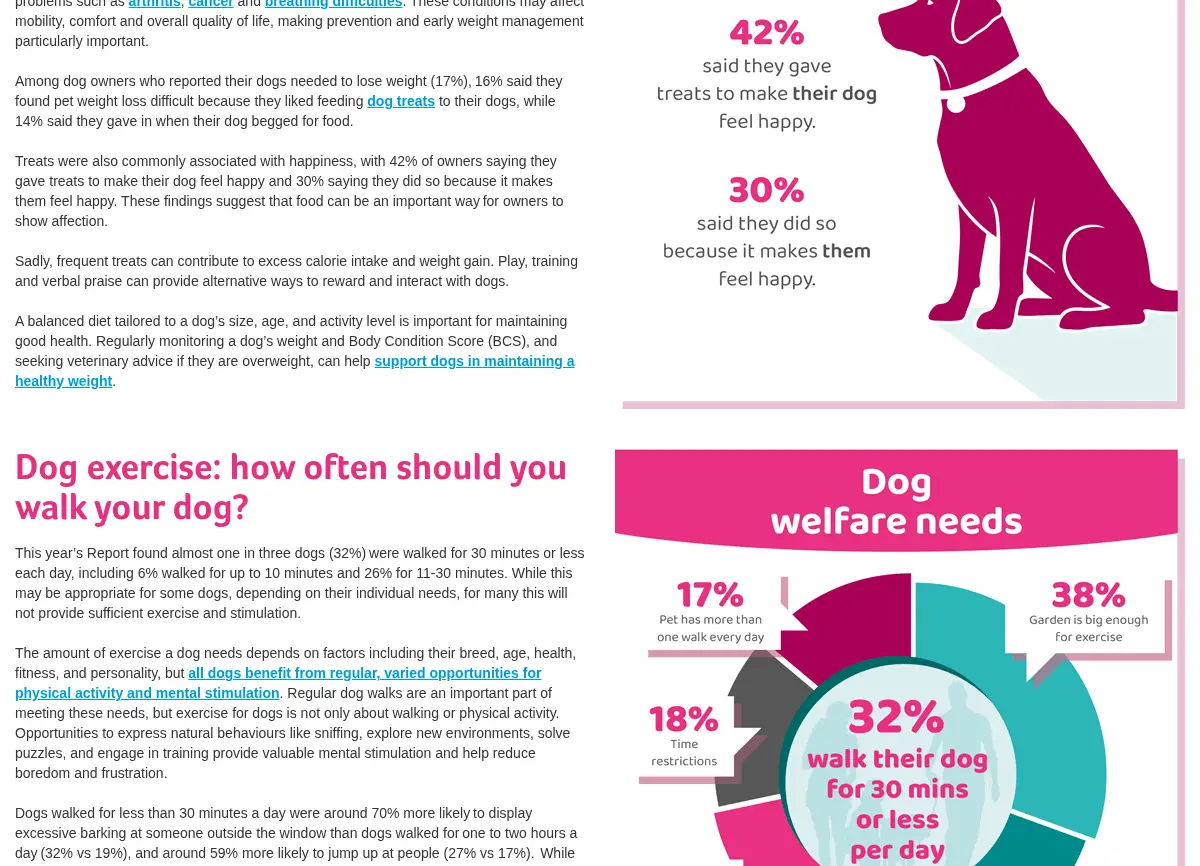
| Up to 10 minutes | 6% |
| 11 to 30 minutes | 26% |
| 31 minutes to 1 hour | 40% |
| Over 1 hour | 28% |
So almost one in three dogs (32%) were walked for 30 minutes or less a day. PDSA says that may be fine for some dogs, but for many it won't give enough exercise and stimulation.
Puppies and senior dogs
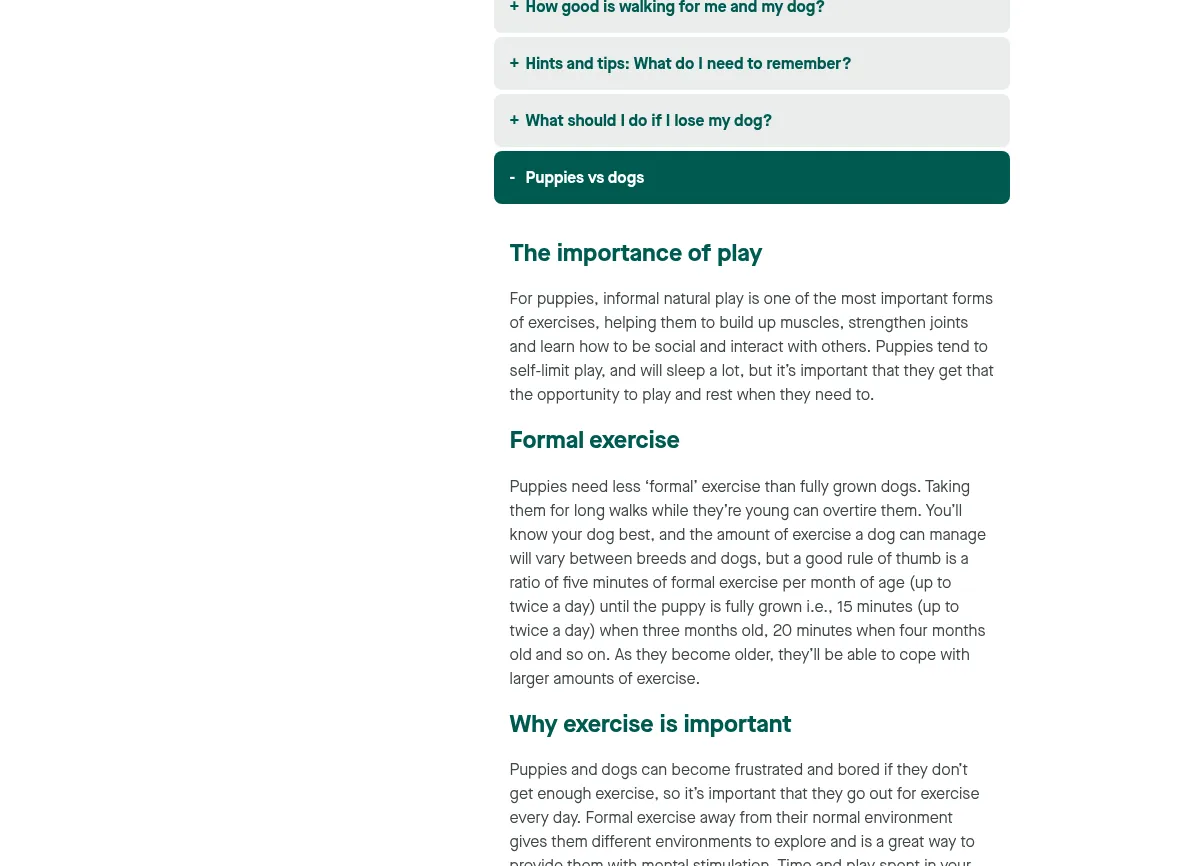
Puppies need less formal exercise while they're growing. The Royal Kennel Club's rule of thumb is five minutes of formal exercise per month of age, up to twice a day, until they're fully grown, so 15 minutes at three months and 20 minutes at four months. PDSA is more cautious: it says there's no scientific evidence behind the five minute rule, and that although it might work for some, it isn't appropriate for most puppies. Keep puppy walks short, add play and training, and ask your vet.
Senior dogs tend to slow down and rest more, PDSA says, but still need to stay active. Its advice is to keep exercise regular and gentle, little and often, because joints get stiffer when they haven't been used for a while. Go at their pace and stop if they look tired or are struggling. PDSA also suggests familiar routes for older dogs who are losing their sight or hearing.
Different ways to exercise your dog
Walks come first, but PDSA lists plenty of other ways to keep a dog fit, and mixing them up helps on days when a long walk isn't possible.
- Brisk and slow walks. PDSA says a brisk walk burns off extra energy, and a slow, sniffy walk is great for their mental health.
- Swimming. A good option if your dog likes water, and PDSA says it's easy on their joints. Follow water safety advice wherever you swim.
- Running. Build up slowly. PDSA suggests short bursts of gentle jogging during a normal walk, then longer stretches over time.
- Hiking. Check the route suits your dog and that they're fit enough, avoid steep scrambles, and take water, snacks and breaks.
- Training. PDSA says training should be part of every dog's daily routine, because it keeps their mind active and prevents boredom.
- Agility and flyball. Good for dogs with energy and an active brain. PDSA says flyball isn't a good sport for very heavy dogs or dogs with joint problems, so ask your vet first.
- Play and brain games. PDSA says play doesn't replace a good walk, but games like tug, fetch and scent games keep your dog active and their mind busy. Feeding puzzles and snuffle mats help on quieter days.
A word on fetch. PDSA says the quick starts and sudden stops of fetch can strain a dog's joints. It advises against throwing things for dogs that are still growing, elderly, injured, arthritic, overweight or prone to joint problems, or on wet or slippery ground. Never throw sticks: both PDSA and the Royal Kennel Club warn they can splinter and cause serious injuries.
Signs your dog isn't getting enough exercise
PDSA says dogs with excess energy often become frustrated, stressed and find it hard to cope. The Royal Kennel Club says dogs can become frustrated and bored if they don't get enough exercise.
The PAW Report 2026 found that dogs walked for less than 30 minutes a day were around 70% more likely to bark excessively at someone outside the window than dogs walked for one to two hours a day (32% compared with 19%). They were also around 59% more likely to jump up at people than dogs walked for over two hours a day (27% compared with 17%). PDSA is clear that this doesn't prove shorter walks cause these behaviours.
Things to look out for, in my view: restlessness at home, chewing or digging, and pulling hard at the start of every walk. These can have other causes, so don't assume a longer walk will fix them. PDSA says a good exercise routine may help unwanted behaviour but is unlikely to fix it completely.
Signs of too much exercise
PDSA's advice is to build fitness gradually and make changes slowly so your dog doesn't get injured. In my view, a dog that lags behind, lies down on walks, limps, or is stiff and slow the next day may be doing too much. Cut back, and speak to your vet if it carries on.
Sniff walks and brain games on short days
Not every walk needs to be long or fast. PDSA says training should be part of every dog's daily routine, because it keeps their mind active and prevents boredom.
On days when time is short, a slow sniff walk plus a training session or a scent game at home can help. The Royal Kennel Club says time in the garden is no substitute for going out for a walk, and PDSA says that even if you have a big garden, regular walks still matter. So a busy day still needs a walk, just a slower one.
When it's hot, cold or wet
PDSA says older dogs don't cope as well with very high or low temperatures. In hot weather it suggests walking at cooler times of day, and in cold weather a suitable coat. Short, slower walks and more play indoors are fine on bad days. My guide to how cold is too cold to walk a dog covers winter walks in detail.
Exercise safety on walks
A longer walk is only good if it's a safe one. PDSA's vets give these tips:
- Recall first. Good recall is essential before your dog goes off lead. PDSA suggests practising with reward based training at home, then in an enclosed garden or park, before trying an open space.
- Collar and ID tag. PDSA says it's a legal requirement for your dog to wear a collar and ID tag in public, with your name and address including postcode.
- Leads. PDSA doesn't recommend extendable leads, as they can be dangerous for you and your dog, especially near busy roads.
- Roads and livestock. Keep your dog on the lead near roads, in built up areas and around livestock.
- Summer. Take water and walk in the cooler hours at the start and end of the day.
- Winter and dark nights. Think about how cold your dog is getting, and use a high visibility jacket, collar or harness when it's dark so they can be seen.
- After meals. The Royal Kennel Club says not to exercise a puppy on a full stomach, as it may contribute to bloat. In my opinion it's sensible to leave a gap after meals for any dog, and to ask your vet about your breed.
Keeping your dog at a healthy weight
PDSA says fit and active dogs are less likely to suffer from arthritis, obesity and behaviour problems. Exercise is only half of it, though. PDSA points out that dogs who eat too much and don't exercise enough put on weight, and that most extra calories from treats turn into fat.
You can do PDSA's home check, called body condition scoring:
- From the side and from above, your dog should have a neat, tucked in waist.
- Their tummy should go in, not bulge out.
- You should be able to feel their ribs, spine and hips easily, without them poking out.
- There shouldn't be a build up of fat where the tail meets the body.
PDSA's vet shows the check in this short video:
PDSA's official video on checking if your pet is overweight, from the PDSA YouTube channel.
If you're worried about your dog's weight, PDSA's weight check advice is a good next step, and so is your vet. Don't add lots of extra exercise to an overweight dog overnight: build it up gradually.
So, how long should a dog walk be?
For most adult dogs, at least one to two walks a day that add up to PDSA's rough figure for their size, adjusted for breed, age and health. Check your breed's band, watch how your dog copes, and change things slowly.
Sources I used
- PDSA, Exercise for dogs, opened 19 November 2026.
- PDSA, Keeping your dog's weight in check, opened 19 November 2026.
- PDSA, Choosing a pet (daily exercise by dog size), opened 19 November 2026.
- PDSA, Exercising your puppy and Exercising your senior dog, opened 19 November 2026.
- PDSA, PAW Report 2026: dogs and press release, 12 October 2026.
- The Royal Kennel Club, Puppy and dog walking tips and Breeds A to Z, opened 19 November 2026.
FAQs
Is a 30 minute walk enough for a dog?
For some small breeds, it can be. PDSA says smaller dogs need 20 to 60 minutes of exercise a day, but medium dogs need around 1 to 2 hours and larger dogs over 2 hours. Check your breed's band on the Royal Kennel Club site.
How many walks a day does a dog need?
At least one, often two. PDSA says most dogs need at least one to two walks a day unless your vet advises otherwise.
Is it OK to skip a walk and let my dog run in the garden?
Not as a habit. The Royal Kennel Club says every dog should have at least one walk every day, and PDSA says that even with a big garden, regular walks matter because they let your dog sniff new smells, explore and meet people and dogs. If you can't walk on a given day, ask a friend or a dog walker.
How long should I walk a senior dog?
Little and often, at their pace. PDSA says to keep exercise regular and gentle and to stop if they look tired or are struggling. Ask your vet if they have joint problems.
Can you over-walk a dog?
Yes. PDSA says to build fitness gradually to avoid injury, and puppies need their growing joints protecting, so keep their walks short.
How long should a dog walk be for a puppy?
Short. The Royal Kennel Club's rule of thumb is five minutes of formal exercise per month of age, up to twice a day, but PDSA says there's no scientific evidence behind that rule and it isn't right for most puppies. Ask your vet.
My dog doesn't like walks. What can I do?
Try to work out why. PDSA lists fear (of dogs, people or going outside), fitness and boredom as common reasons. For fear, it suggests an accredited behaviourist; for fitness, a chat with your vet; for boredom, more time to sniff and play, a better time of day, or a dog walker.
How should I walk a reactive dog?
PDSA says to avoid other dogs as much as possible while you work on their behaviour with an accredited behaviourist: walk at quieter times and places, or hire an enclosed paddock. If you meet another dog, walk away calmly with a treat or toy, ideally putting a gate, fence or car between them. I also offer reactive dog training in Heywood.
How much should I walk a dog with arthritis?
Regularly, but gently. PDSA says to keep arthritic dogs moving through the day so their joints don't seize up, with low impact exercise: walking and gentle running are fine, but avoid chasing, jumping, skidding and steep slopes. Pavements and grass may be easier than sand or gravel.
The Dog Geezer
Need a hand in Heywood, Rochdale, Middleton or Bury?
If you can't always fit in the walks your dog needs, have a look at dog walking in Heywood, Rochdale, Middleton and Bury, and join the waiting list. If you're wondering about cost, see how much a dog walker costs in the UK, or how many dogs a dog walker can walk. Fully insured and DBS-checked.
Cheers, James